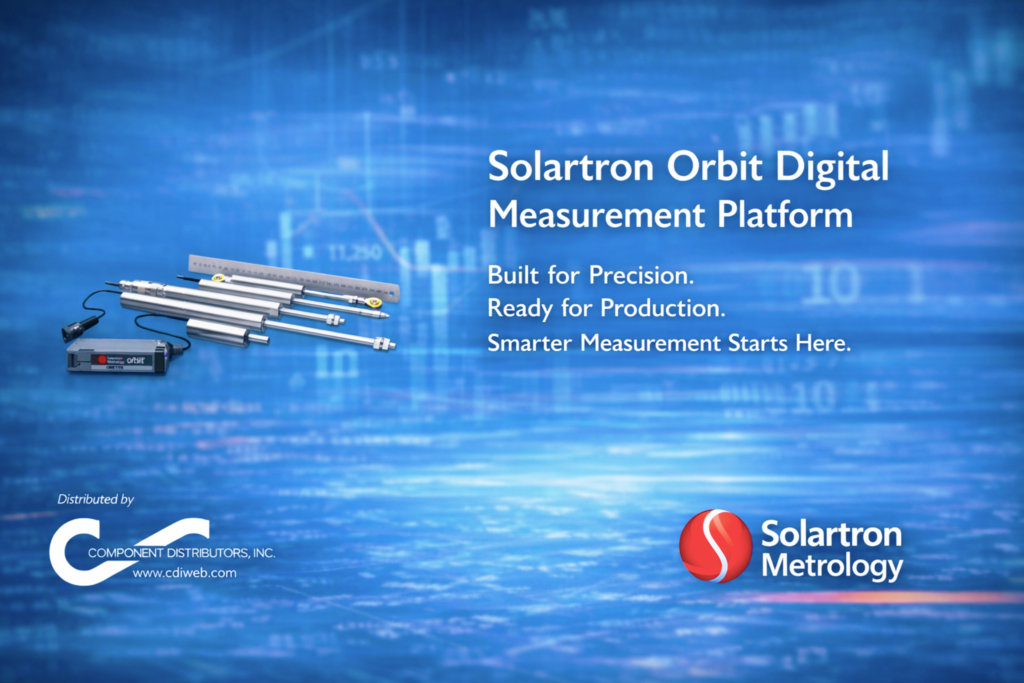
Manufacturers today operate under increasing pressure to meet tighter dimensional tolerances, higher throughput demands, and evolving material requirements. From lightweight composites and precision-machined metals to delicate glass and electronic components, modern production environments require measurement systems that deliver both exceptional accuracy and industrial robustness. Solartron Metrology, available through Component Distributors Inc. (CDI), provides a comprehensive portfolio of precision sensing technologies designed to support automated control, in-line quality verification, and laboratory validation. By combining resilient mechanical design with advanced digital signal processing, Solartron solutions help manufacturers improve process capability, reduce rework, and achieve consistent product quality.
A Comprehensive Portfolio of Contact and Non-Contact Measurement Solutions
The Solartron measurement portfolio includes contact and non-contact technologies that enable standardized metrology strategies across R&D, quality assurance, and production operations. Gauging probes, flexure gauges, block gauges, LVDT displacement transducers, optical encoders, and laser-based sensors are engineered to address diverse application requirements while maintaining consistent measurement performance. Specialized probe variants such as low-tip-force designs allow inspection of fragile surfaces, while rugged LVDT solutions provide reliable position feedback in harsh environments affected by vibration, contamination, or electrical interference.
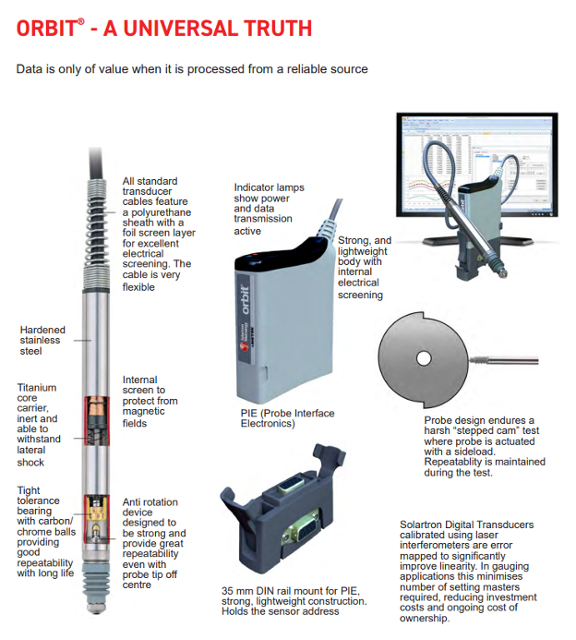
Figure 1. Solartron Orbit® platform hardware and transducer construction overview.
Orbit® Digital Measurement Network Architecture
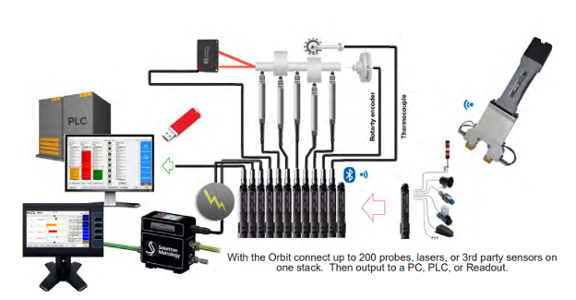
At the core of Solartron’s metrology ecosystem is the Orbit® digital measurement network, a scalable architecture that aggregates data from multiple sensors through modular interface electronics. This platform enables synchronized, high-speed data acquisition while maintaining strong immunity to electrical noise. Orbit® supports seamless integration with PLCs, SPC software, and industrial data infrastructures, allowing measurement data to be leveraged across automated production systems and advanced analytics environments.
Key Advantages of Orbit® Measurement Architecture
High-speed, deterministic data acquisition across multi-sensor measurement arrays
Modular scalability to support future system expansion and standardized deployment
Reduced calibration frequency through stable linear measurement performance
Figure 2. Orbit® network architecture enabling multi-sensor integration and real-time data flow.
Non-Contact Measurement for Sensitive and Dynamic Applications
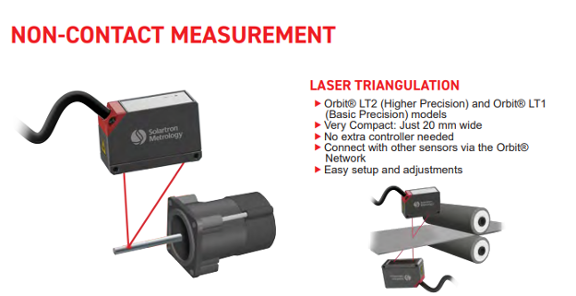
In applications where physical contact may alter surface integrity or where measurement targets are moving at high speed, Solartron’s non-contact optical and laser triangulation sensors provide an effective solution. These technologies deliver high accuracy and bandwidth while minimizing mechanical influence on the measured component. As a result, manufacturers can implement hybrid measurement stations that combine contact probes with non-contact sensors, ensuring optimal performance across varying surface finishes, geometries, and production conditions.
Figure 3. Laser triangulation non-contact measurement solutions integrated within the Orbit® ecosystem.
High-Stability LVDT Displacement Measurement
Solartron LVDT displacement transducers further enhance system performance by providing high linearity, long-term stability, and resistance to environmental contamination. These sensors are widely used for machine alignment, tooling compensation, material deformation analysis, and precision actuator feedback. Their durable construction and noise-optimized electronics enable consistent measurement accuracy over extended operational lifetimes, reducing maintenance requirements and minimizing total cost of ownership.
Core Performance Characteristics
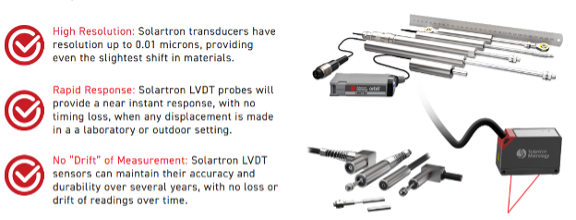
Sub-micron resolution capable of detecting minimal dimensional shifts
Rapid response time enabling near-instant measurement feedback
Long-term accuracy stability with minimal drift over time
Figure 4. LVDT displacement transducers and performance characteristics.
Industry Applications and Implementation Value
Solartron Metrology technologies are deployed across key industrial sectors including automotive and electric vehicle production, aerospace manufacturing, electronics assembly, and medical device fabrication. By combining precision sensing hardware with scalable digital measurement infrastructure, organizations can establish a future-ready dimensional control strategy that improves production efficiency, enhances quality outcomes, and supports advanced manufacturing initiatives.
Implementation Support Through CDI
Through CDI’s application expertise and technical support, manufacturers can accelerate deployment, improve measurement performance, and achieve measurable operational gains.